Here’s the cover for our upcoming manual, “Story Finders: How Counselors and Teachers Can Help Students Write Better College Essays (Without Helping Too Much).”
We’ve finished the book and the formatting. It will be available for sale in September.
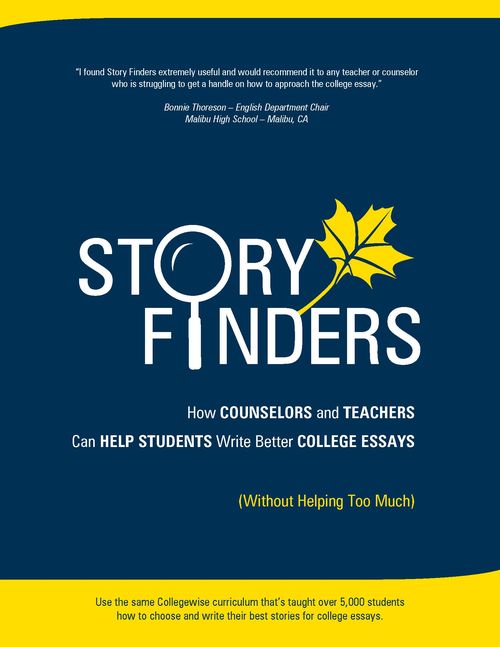
Here’s the cover for our upcoming manual, “Story Finders: How Counselors and Teachers Can Help Students Write Better College Essays (Without Helping Too Much).”
We’ve finished the book and the formatting. It will be available for sale in September.
College application gimmicks are great for one thing—stories. Sending a box of cookies to the admissions office wrapped in a ribbon that matches the school colors is a gimmick. It won’t help you get in, but it’s exactly the kind of story that gets passed from one application generation to another. Just because the story survives doesn’t mean it’s a good idea.
College application gimmicks don’t work. The admissions officers may gladly eat your cookies, but it’s not going to sway their admissions vote. Neither will sending in a CD of you singing the school fight song, sending along a list of “Top Ten Reasons to Admit Me,” camping out in front of the admissions office with a sign that says, “Will work for admission.”
What does work?
Nobody ever got admitted to their dream school because of a gimmick. And if you know a student who tried a gimmick and was accepted, remember that it’s likely he or she was accepted in spite of the gimmick, not because of it.
Side note: It’s not gimmicky if a college invites you to do it, as Tufts did when this mechanical engineering (“ME”) hopeful submitted a YouTube video as part of his application (Jumbo the elephant is Tufts' beloved mascot).
A student at one of our free seminars yesterday asked:
“Someone on an online college admissions chat I read said that it’s a good idea to insert a picture of yourself into your essay, or to say ‘thank you’ with a smiley face at the end, just as a way to make your essay a little more memorable. Is that really a good idea?”
My advice? Get off the online chats.
This was obviously a nice, smart kid. He deserves better than (bad) advice from anonymous online posters.
College admissions is a subject for which lots of people are quick to give free advice even when they have no idea what they are talking about. But anonymous online advice is the worst kind because you don’t know them, and they don’t know (or care about) you.
High school counselors, private counselors, admissions officers, even your older brother or sister who’s been through the process and can share what they learned—these people know something about college admissions. But more importantly, they care about you. They care about their professional reputations. They’ve got a personal stake in seeing you succeed.
Learning about and asking for advice about college admissions is a good thing. But one of the reasons this process has gotten so confusing is that there’s almost too much information and advice available. The first step towards making sense of all this might be to ignore the stuff from anonymous sources and people who don’t work in college admissions. Get your advice from people you know who are also in-the-know.
It’s sad how many high achieving students don’t have an answer to the “What do you do for fun?” question. (Not one that really makes them light up, anyway).
Do you have an answer? Is it a real one, or just another reason to talk about something you think will help you get into college?
“I’ve played the violin for eight years” is a line from a resume, not an answer about what you do for fun.
But…“I love playing country music on the violin; nobody in the orchestra can play a mean fiddle like I can.”
Now we’re talking.
There’s such a thing as being too focused on getting into college. If you make every decision based on how it will play out in college admissions, you’re going to come off like a drone who’s motivated more by a sense of competition then you are by real passion. And you aren’t going to have any fun.
So yeah, take hard classes. Study for your SATs. Stay up late preparing for your chemistry midterm. But goof off a little, every now and then, too. Play some video games. Throw a Frisbee. Throw water balloons. Be a kid for crying out loud.
Colleges want students who are hard workers. But they also want people who enjoy having a little fun. Show them you know how to do both.
Colleges want to know that you are going to be a contributing member to their campus community. That means that they aren’t just evaluating the activities in which you participated; they're looking for students who made an impact during their involvement.
Sometimes the impact you make is big and noticeable. Other times, it’s more subtle. But big or small, impact is important. So make sure to communicate where you made yours.
For example:
Colleges know that these students won't stop making their impact once they get to college. When you're applying, think about ways you might be able to make an impact once you get there. Then talk about how you see yourself doing it. Your ideas for contributions don’t have to be big, like starting a campus-wide community service group. They can be small things that make other peoples' college experiences even better.
For example:
In your essays and applications, try to communicate at least one way in which you made an impact on your school, community, club, team, organization, etc. If you’re given the opportunity, talk a little bit about what you’ll give back once you get to college, too.
And remember that for your colleges to believe you when you describe how you will contribute, it’s best to be honest and not worry so much about being impressive. If you can more easily see yourself baking cookies for your dorm than you can starting a community outreach program, tell the truth about your baking prowess.
On 8/20 and 8/27 in our Irvine, CA offices, we've decided to film videos of Arun and me doing our most popular Collegewise seminars. Collegewise families and their special guests have already had the opportunity to register, but we've got a few seats left at two of the seminars (and we can’t possibly unleash our full Hollywood speaking potential to anything less than a packed house). So we're opening them up to the public now until the seats are full.
Here are the available seminars and the information for how to register.
Saturday, August 20
How to Write Great College Essays
11:30 a.m. – 12:30 p.m.
A lot of good kids write bad college essays about how soccer taught them the importance of teamwork, or how they struggled to adapt to strange cultures during a trip to Paris. Come to this seminar to learn what admissions officers want (and don't want) to read, and how to identify stories that will make your application stand out. I'll be doing this seminar.
Saturday, August 27
College Admissions 201: Admission to The Most Selective Colleges
11:30 a.m. – 12:30 p.m.
This seminar will teach you how schools like the Ivy Leagues, Stanford, Duke, and the rest of the nation’s most selective colleges make decisions from pools full of the most qualified applicants. And it will feature Arun–a partner at Collegewise, a former Assistant Director of Admissions at Caltech and the University of Chicago, and a former admissions reader for UCLA.
Location:
The Collegewise offices:
2081 Business Center Dr., #280, Irvine, CA 92612
To RSVP:
Just drop an email to ocseminars@collegewise.com and tell us which seminars you’d like to attend and how many will be attending. We'll set up an auto reply so you'll get a confirmation of your RSVP. If the seminars fill up, I'll mention it here, and I'll change the auto-reply so new registrants will know that we were too full to accept their reservation.
Two important things before your register:
1. All attendees will be required to sign a release form giving us permission to use your image in our video should the camera happen to pass over you during the presentation (don't worry–we won't be asking you to do anything other than enjoy yourselves).
2. Once filming starts, we can't allow any late arrivals into the room. We'll be closing the doors at the exact start time of the seminar, so please get here 10 minutes early.
We hope to see you here!
Parents, if you’re feeling anxious about your student’s college process, if you're worrying more than you’d like to worry about GPAs, SAT scores, and whether or not the dream school will say yes, try this.
Talk to any parent whose recently graduated senior is now packing and preparing to leave for college.
Some of those parents’ kids got into their dream schools—many more of them did not. But most future college freshmen can’t help but be excited about what’s in store, whether or not the school is famous. And happy kids make for happy parents.
After all the report cards, SAT scores, tutors, broken curfews, breakups, slipups, rejections, and everything else that seemed so trying during the high school years, watching your student leave for college—any college—is a pretty exciting day.
It’s happening for them, and it will happen for you, too.
We try to be optimistic about college planning at Collegewise. But there’s one time when we always assume the worst–when a family misses a meeting or two and doesn’t return our phone calls.
Back when I first started Collegewise, a family that had just left another private counselor came to us. They had recently flown to Houston so their father could receive emergency treatment for an aggressive form of cancer he’d just been diagnosed with. And while they they were gone, they missed an appointment with their private counselor. The only phone call they received was, apparently, to notify them that they now owed a $75 fee for their missed appointment. Another counselor’s mistake became a free lesson for us.
We expect kids to be responsible, to remember their appointments, and to show up on time. But when they don’t, we call the family to let them know that we hope everything’s OK. If we don’t hear back from them, we call again and send an email. And if we still don’t hear back, we mail an old-fashioned letter home letting them know how worried we are, asking them to please check in when they can, and to let us know if there’s anything we can do.
97% of the time, the missed appointment can be chalked up to teenage forgetfulness. But we approach it assuming the family is in the remaining 3%. We’ve had occasions where students have been in serious accidents. We’ve had scenarios where parents didn’t know that a reluctant college applicant had been skipping his meetings. And there have even been a few occasions when it was our mistake and we’d written the appointment wrong in our calendars. But whatever the reason, we’re always glad we gave that remaining 3% the benefit of the doubt and assumed the worst.
And once we know everyone is fine, then we can get back to our usual optimistic selves.
Today, Collegewise is celebrating its 12th birthday. It’s hard to believe that in just two short years, we’ll be working with kids who weren’t born yet when I filed our paperwork with the County Clerk’s office in 1999 and started driving to kids’ houses to help them fill out college applications at their kitchen tables. We’ve since helped over 3,000 kids find, apply to, and attend the right colleges for them. And we’re still doing what we’ve always done—helping families appreciate just how many great colleges there are, not just the famous schools, and we’re showing them how to make the process enjoyable and exciting.
And while our counselors have been busy helping this year’s Collegewise students, Arun and I have been working to release our projects I mentioned back in May in this post. It’s taken us much longer to finish these than we thought it would, but we’re very close to bringing Collegewise to a much wider audience of families. Here are a few updates.
New page on our website
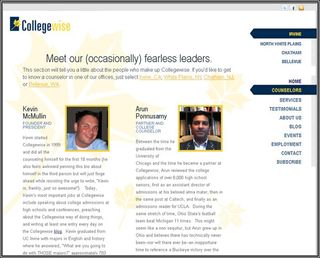
We’ve added a page with bios for Arun and me so we aren’t just faceless mentions on the blog. Neither of us is entirely comfortable being photographed (or writing bios of ourselves), but we’re trying to follow our own advice and share everything—and everyone—behind our small business.
The Collegewise Store
Our designer has done all the design and programming for us to offer a suite of Collegewise products. We’ll be testing it for the next couple weeks to make sure there aren’t any bugs, and as soon as it’s ready, we’ll put up some of the products below.
Is There a Future Doctor in The House?: A Guide to Choosing a College and Preparing for Life As a Premed
We’ve finished our guideline and will be selling it as a PDF that families can download from our store.
Online Collegewise counseling
Sometimes, you have to do the hard thing, blow up a nearly-finished project, and start again from scratch. We were just about ready to launch our online counseling where students anywhere in both the United States and the world will be able to meet with a Collegewise counselor by video chat. But we thought the interface was just too complicated and didn’t like that a user would have to click through 8-9 pages before they could buy a product. So Arun and I hunkered around our laptops one day at his loft, rewrote the entire project, and got it down to a much simpler, cleaner version for the user. Our designer says it will be ready to go in 2-3 weeks. After we test it, we’ll make a big, bold announcement here on our blog.
Story Finders: How to Help Students Write More Effective College Essays (Without Helping Too Much)
This project is done and is currently in the formatting stage. We’re going to sell this as an on-demand published book for teachers and counselors, sharing our entire Collegewise system of brainstorming and editing essays (and how we do it without hijacking the kids’ process and helping too much). We’ve also prepared a resource page where buyers will be able to download clean copies of our materials.
Collegewise seminar videos
Over the next two weekends, we’re bringing a film crew to our offices in Irvine and filming four of our most popular seminars.
We’ll then be selling them as streaming downloads, and also as DVDs for counselors and schools that want to show them to larger audiences. I’ll post some photos of our blockbuster-type video shoots (plus I get to say “video shoots,” which makes us sound so Hollywood).
How to Make your Common Application A Lot Less Common
We’re 90% done with our step-by-step guide to filling out the Common Application, sharing all of our tips to make your application more compelling. We also secured permission from the Common App folks to include screen shots in our guideline, which really helps make our explanations clearer. It’s currently at 54 pages, and we’re just finishing the final few pages explaining how to double check everything before a student hits “Submit.” We’ll be selling this as a PDF download on our store.
If you follow our blog, you’ve probably noticed that this isn’t our first mention of these projects. We’re learning just how long these things take as we go, but we promise that we are, in fact, working to finish all the cool products we’ve mentioned so excitedly here. We’re feeling a lot better about our progress now, and we promise to post loudly and proudly when they’re done.
From the article "10 Reasons to Skip the Expensive Colleges":

Going to an elite university does not guarantee success. To prove this point, Hacker and Dreifus tracked the 900-odd students who graduated from Princeton in 1973 to see if the school was delivering on its promise 'to prepare students for positions of leadership,' whether in business, public service, or the arts, which Princeton administrators claim as their goal. 'We were very disappointed,' Hacker says. 'There were only a handful of recognized names in that class of 900. What that tells us is simply this: In America, if you put your talents to their best use, by the age of 35 or 36, you’ll be passing people from Princeton, no matter where you went to school.'"